Skipping HVAC maintenance in Pueblo costs homeowners an average of $1,200–$2,500 per year in excess energy consumption and avoidable repair bills. That’s the real number we see when comparing our maintenance customers’ service histories against those who only call when something breaks. Regular tune-ups aren’t an upsell—they’re the single most cost-effective thing you can do for your heating and cooling equipment.
What Happens When You Skip Maintenance
HVAC systems don’t fail suddenly. They degrade gradually, performing a little worse each season until something finally gives out. Here’s the typical progression:
Year One Without Maintenance
Dust accumulates on the evaporator and condenser coils, reducing heat transfer efficiency by 5–10%. The system runs slightly longer cycles to compensate. Energy bills increase by $10–$20 per month. You probably won’t notice.
Year Two Without Maintenance
The blower motor works harder against the restricted airflow from a dirty filter (if you haven’t changed it) and fouled coils. Capacitors begin to weaken under the increased electrical load. Refrigerant may be slightly low from a slow leak that would have been caught during an inspection. Efficiency drops 15–20%. Your monthly costs are now $30–$50 higher than they should be.
Year Three Without Maintenance
A capacitor fails on the hottest day of summer, or the igniter cracks during the first cold snap. Now you’re paying emergency rates for a problem that a $15 capacitor or $45 igniter would have prevented during a scheduled visit. The emergency repair costs $250–$500, and you spent $500–$900 more on energy over those three years than a maintained system would have cost.
What Professional Maintenance Actually Includes
A legitimate HVAC tune-up goes far beyond “checking the filter.” Here’s what our technicians inspect and service during a maintenance visit in Pueblo:
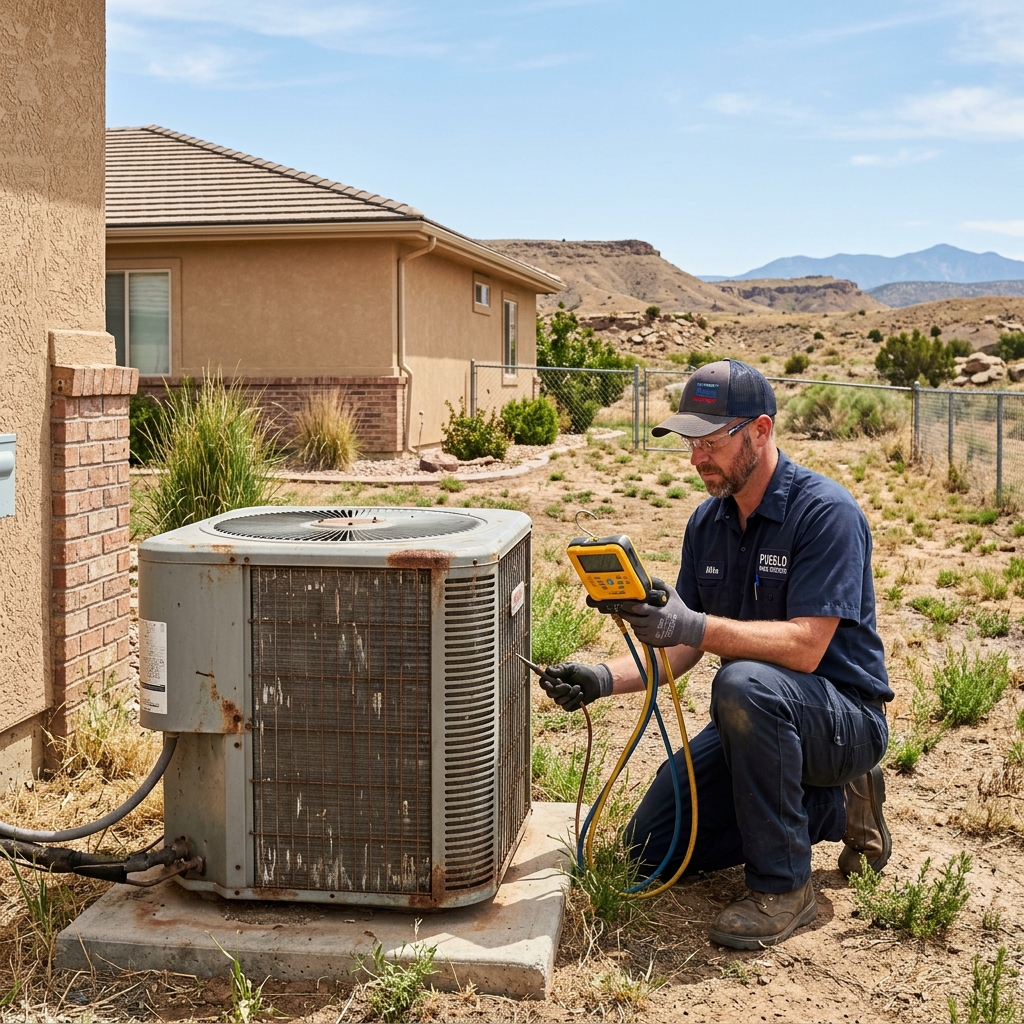
Cooling Season (Spring)
- Verify refrigerant charge and check for leaks
- Clean condenser and evaporator coils
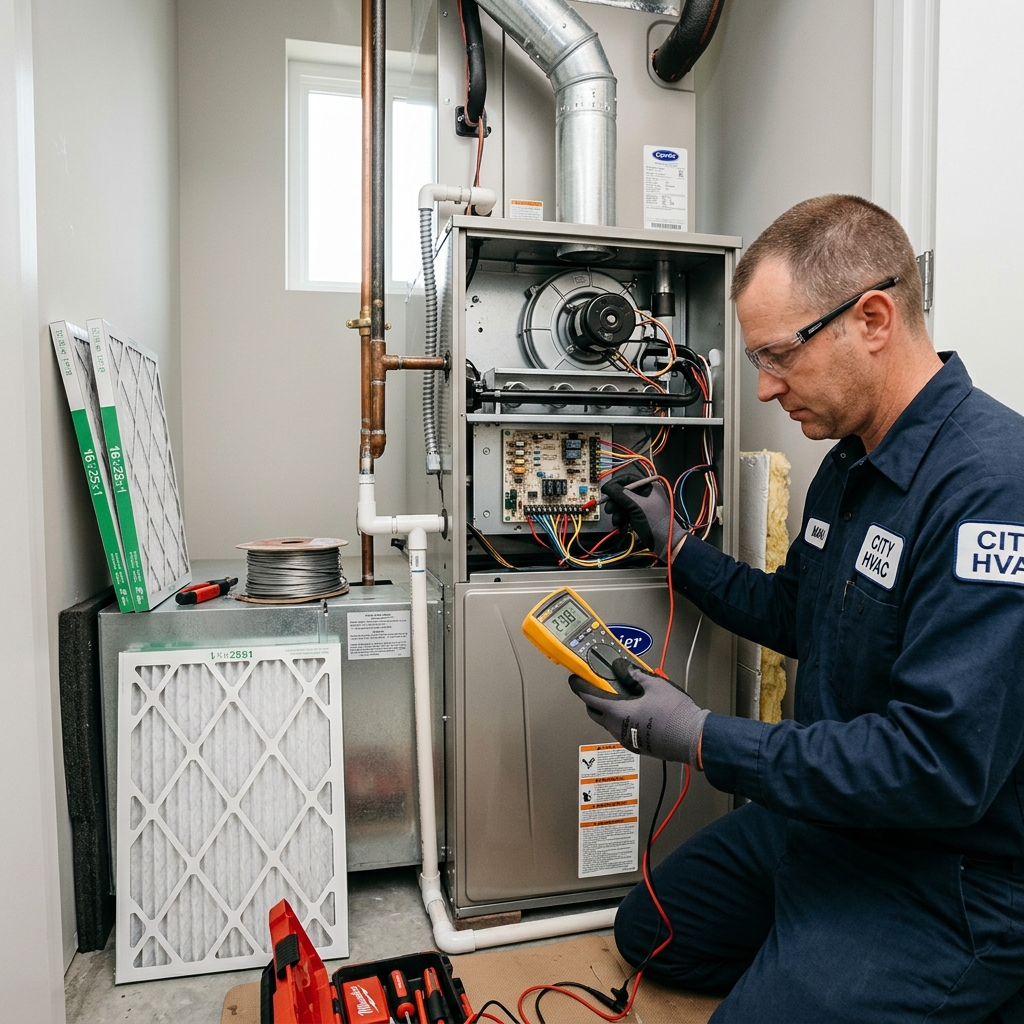
- Test capacitor strength with a meter (not just visual inspection)
- Inspect contactor points for pitting and arcing
- Measure temperature differential across the evaporator coil
- Check thermostat calibration and programming
- Lubricate motor bearings where applicable
- Clear condensate drain line
- Inspect electrical connections and tighten terminals
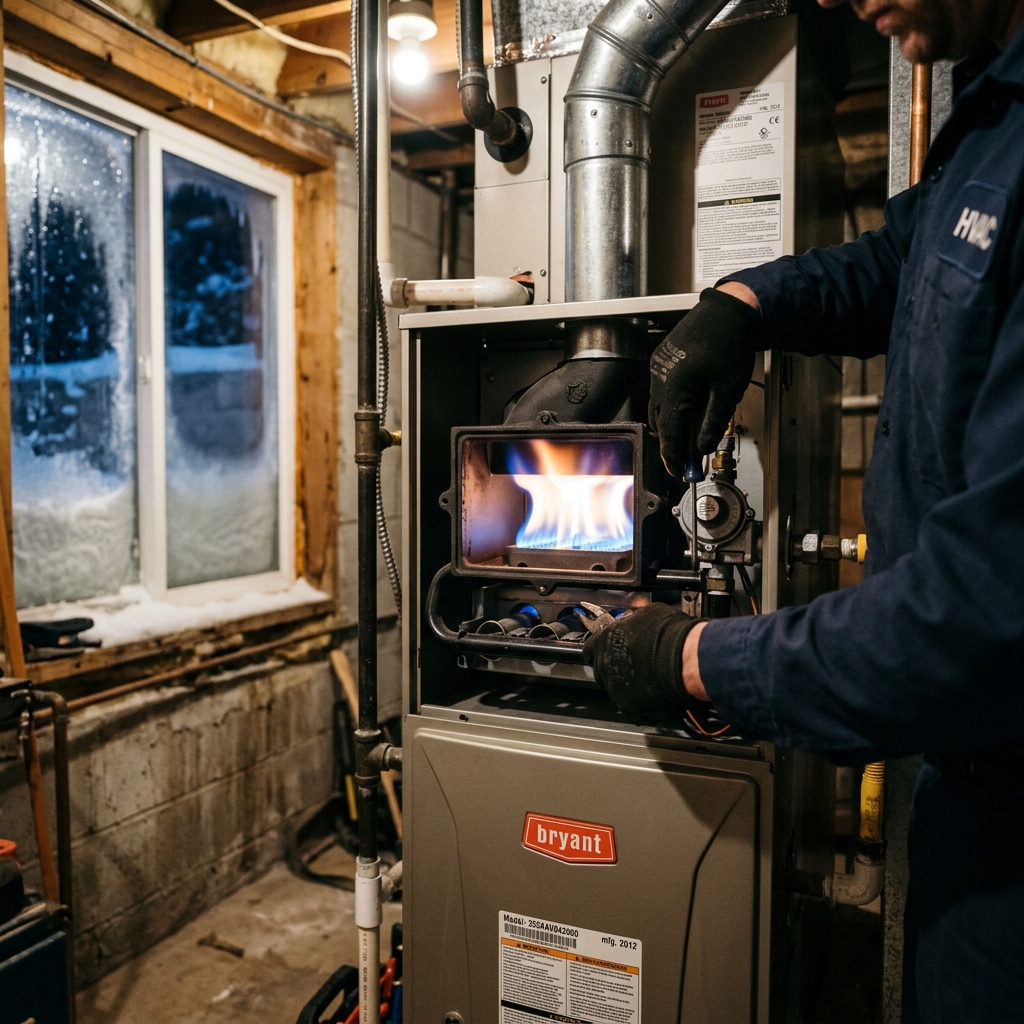
Heating Season (Fall)
- Inspect heat exchanger for cracks using a combustion analyzer
- Test ignition system and flame sensor
- Verify gas pressure and adjust for altitude (critical in Pueblo at 4,692 feet)
- Test safety controls including high-limit switch and pressure switch
- Check carbon monoxide levels in the supply air
- Inspect flue pipe and venting for blockages or disconnections
- Test thermostat heating cycle
- Inspect blower wheel and motor condition
Why Pueblo’s Climate Makes Maintenance More Important
Our semi-arid environment accelerates several types of HVAC wear:
- Dust accumulation on coils and in ductwork is 2–3x faster than humid climates. Without regular cleaning, this dust acts as insulation that prevents heat transfer.
- UV degradation at altitude breaks down rubber gaskets, wire insulation, and refrigerant line insulation faster. Annual inspection catches deterioration before it causes a leak or short circuit.
- Extreme temperature cycling—from 0°F winter nights to 105°F summer days—puts thermal stress on every component. The expansion and contraction loosens electrical connections and cracks brittle components.
Homes in Penrose, Florence, and Canon City face even more extreme temperature swings due to their canyon and valley locations, making maintenance there even more critical.
The Real Return on Investment
A twice-yearly maintenance plan in Pueblo typically costs $150–$300 annually. Based on our service data, that investment delivers:
- 10–15% lower annual energy costs ($200–$400 savings)
- 80% fewer emergency repair calls
- 5–7 additional years of equipment life on average
- Maintained manufacturer warranty coverage (most warranties require documented maintenance)
Frequently Asked Questions
Twice per year: once in spring before cooling season and once in fall before heating season. In Pueblo’s demanding climate, this schedule catches seasonal issues before they become expensive problems during peak usage.
You can handle filter changes, keeping the outdoor unit clear, and basic thermostat programming. But testing refrigerant charge, electrical components, and combustion safety requires professional tools and training. DIY maintenance complements professional tune-ups but doesn’t replace them.
No system is breakdown-proof. However, maintenance catches 80%+ of potential failures before they occur. The remaining 20% are typically covered by manufacturer warranties on maintained systems, minimizing your out-of-pocket exposure.
Most major manufacturers require documented annual maintenance to honor warranty claims. If your system fails due to a problem that routine maintenance would have prevented, the warranty claim can be denied. Keep your maintenance records.
A good Pueblo HVAC maintenance plan includes two annual tune-ups (spring and fall), priority scheduling for repairs, discounted parts and labor rates, and no overtime charges for after-hours emergency calls. Some plans include a filter subscription too.